Houston has 418 FLL (Federal Firearms License) holders, Chicago has ZERO.
Houston and Chicago are the 3rd and 4th largest cities in the US, how do the murder rates compare and are the local gun laws working.
City Overviews
Houston
Houston, the most populous city in Texas and the fourth largest in the U.S., is a dynamic and rapidly growing metropolis with an estimated population of around 2.3 million people. Known for its massive sprawl, the city is a global center for the energy industry, which significantly shapes its economy. The median household income is approximately $64,000. Demographically, Houston is celebrated as one of the most diverse cities in the nation. It has a majority-minority population, with Hispanic residents forming the largest group at roughly 44%, followed by non-Hispanic White residents at 24%, Black residents at 22%, and Asian residents at about 7%. This multicultural fabric is a defining characteristic of the city’s identity, influencing everything from its cuisine to its culture.
Chicago
Chicago, the third-largest city in the United States, anchors the Midwest with a population of approximately 2.7 million residents. It stands as a major international hub for finance, commerce, industry, and technology. The city’s economic profile is diverse, contributing to a higher median household income of about $75,000. For decades, Chicago’s demographic landscape has been a complex tapestry of cultures. The city’s racial composition is roughly 39% White (including Hispanic), 28% Black, and 7% Asian. A significant portion of the population, about 30%, identifies as Hispanic or Latino, making them the largest minority group. This mix of backgrounds has created a city of distinct neighborhoods, each with its own rich history and cultural identity.
Comparison
When comparing these two American giants, several key differences emerge. Chicago is the more populous city, though Houston has experienced more rapid growth in recent decades. Economically, Chicago boasts a higher median household income by about $11,000, reflecting its diverse and long-established financial and commercial sectors compared to Houston’s energy-centric economy. The most striking contrast, however, is in their demographic structures. Houston’s population is defined by its large Hispanic plurality, making it a majority-minority city where no single group forms a majority. Chicago, while also incredibly diverse, has a larger proportion of White and Black residents compared to Houston, and its Hispanic population, though substantial, is a minority group rather than a plurality. These fundamental differences in population, economic drivers, and racial makeup create two unique urban experiences.
Gun Laws
Houston and Texas Gun Laws
Gun laws in Texas, and by extension Houston, are among the least restrictive in the United States, rooted in a strong interpretation of the Second Amendment. The most significant policy is Constitutional Carry, which allows most Texas residents aged 21 and over to carry a handgun, either openly or concealed, in most public places without a permit. While a License to Carry (LTC) is still available and offers benefits like reciprocity with other states, it is not a requirement for legal carry within Texas. Furthermore, Texas has no state-mandated waiting period for firearm purchases and does not ban any specific types of firearms or magazines based on capacity. The state also has a “stand your ground” law, which allows individuals to use deadly force in self-defense without a duty to retreat.
Chicago and Illinois Gun Laws
Chicago’s gun laws are shaped by both city ordinances and Illinois state law, which are significantly more stringent than those in Texas. To legally purchase or possess a firearm or ammunition in Illinois, a resident must have a Firearm Owners Identification (FOID) card, which is issued by the state police after a background check. When purchasing a firearm, there is a mandatory 72-hour waiting period for handguns and a 24-hour waiting period for rifles and shotguns. In 2023, Illinois enacted the Protect Illinois Communities Act, which bans the sale and distribution of many common semi-automatic firearms defined as “assault weapons” and magazines capable of holding more than 10 rounds for rifles and 15 for handguns. While the state now has a concealed carry licensing system, local regulations in places like Chicago can add further restrictions on where firearms can be carried.
Stark Contrasts in Firearm Regulation
The legal frameworks governing firearms in Houston and Chicago represent two fundamentally different approaches to gun control. Houston operates under a permissive system where the right to carry a firearm is presumed for most adults, with minimal barriers to purchase and possession. In stark contrast, Chicago’s system is highly regulatory, requiring residents to first obtain a license merely to own a firearm and imposing significant restrictions on what types of firearms can be purchased and when a buyer can take possession. The result is a legal landscape where the rights and responsibilities of a gun owner in Houston are vastly different from those of one in Chicago.
Murder Rates
Chicago’s 2024 Murder Landscape
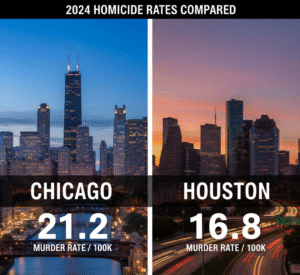
In 2024, Chicago continued a significant and encouraging downward trend in homicides. The city recorded 573 murders for the year, a notable decrease from the 620 logged in 2023. Based on its population of approximately 2.7 million, this yielded a murder rate of roughly 21.2 homicides per 100,000 residents. While this rate represents a marked improvement and the lowest since 2019, it remains substantially higher than that of many other large American cities. Law enforcement attributed the progress to strategic deployments and technology-driven policing, though the sheer volume of violence continued to be a primary focus of city leaders.
Houston’s Homicide Situation in 2024
Houston also experienced a positive trend in 2024, with the Houston Police Department reporting a final count of 386 murders, an 8.8% decrease from the previous year. For its population of around 2.3 million, this translates to a murder rate of approximately 16.8 homicides per 100,000 people. This reduction was part of a broader, though modest, decrease in overall violent crime. City officials pointed to targeted initiatives aimed at violent offenders as a key factor. While the decline was celebrated as a step in the right direction, public safety and violent crime remained a top concern for residents.
Comparative Overview of Homicide Rates
When normalizing for population, the data from 2024 provides a clearer picture of violence in each city. While both Chicago and Houston saw commendable reductions in homicides, Chicago’s murder rate of 21.2 per 100,000 people was notably higher than Houston’s rate of 16.8 per 100,000. This means that despite having different legal and demographic landscapes, the risk of falling victim to homicide was statistically higher for a resident of Chicago than for a resident of Houston in 2024. Both figures, however, reflect a broader, nationwide trend of decreasing murder rates following the spike during the pandemic years, even as they highlight the unique public safety challenges each city continues to face.
So tell me are the gun laws working?
AI assistance in the creation of this article.