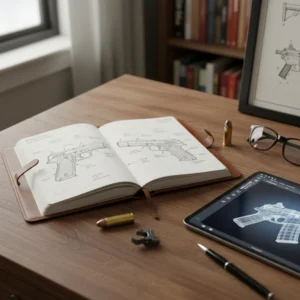
Welcome to our firearms glossary. Whether you’re a new gun owner or a seasoned enthusiast, the terminology used in the firearms world can often seem like a language of its own. This guide is designed to be your go-to resource, breaking down everything from the basic parts of a firearm to complex legal and performance terms. Our goal is to empower you with the knowledge needed for safe handling, informed purchasing, and clear communication.
Firearms Glossary: Table of Contents
- Core Firearm Components
- Ammunition Terminology
- Types of Firearm Actions
- Shooting & Performance Terms
- Optics, Sights & Accessories
- Legal & Regulatory Terms
- Shotgun-Specific Terms
Core Firearm Components
Action: The mechanism of a firearm that loads, fires, and ejects a cartridge.
Barrel: The metal tube through which the projectile is fired.
Bore: The inside channel of the barrel.
Breech: The rear end of the barrel, where the cartridge is inserted.
Chamber: The portion of the breech that holds the cartridge when ready to fire.
Crown: The muzzle end of the barrel’s rifling, cut to ensure the projectile exits cleanly.
Cylinder: The rotating part of a revolver that contains multiple chambers.
Ejection Port: The opening on the receiver where a spent casing is ejected.
Extractor: A small hook that pulls a spent casing from the chamber.
Firing Pin: The pin that strikes the primer of a cartridge to cause ignition.
Frame: The main structure of a handgun to which the other parts are attached.
Grip: The part of the firearm held by the hand.
Hammer: A part that strikes the firing pin or primer to cause the gun to fire.
Magazine: A container for holding and feeding cartridges into the action.
Magazine Release: The button or lever that releases a detachable magazine from the firearm.
Muzzle: The front end of the barrel from which the projectile exits.
Receiver: The main body of a firearm (typically a rifle or shotgun) which houses the action.
Rifling: The spiral grooves inside the bore that spin the bullet for stability and accuracy.
Sear: A critical part of the trigger mechanism that holds the hammer or striker until the trigger is pulled.
Sights: The devices used to align the barrel with a target.
Slide: The upper part of a semi-automatic pistol that moves back and forth to eject a spent casing and chamber a new round.
Stock: The rear part of a rifle or shotgun that rests against the shoulder for support.
Trigger: The lever that, when pulled, initiates the firing process.
Trigger Guard: The loop of metal or polymer that surrounds the trigger to prevent accidental discharge.
Ammunition Terminology
Ballistics: The science of projectiles in motion.
Bullet: The projectile that is fired from a rifle or handgun.
Caliber: The diameter of the bullet or bore, measured in inches or millimeters.
Cartridge: A single unit of ammunition, consisting of a casing, primer, powder, and projectile. Also known as a “round.”
Casing: The metal (usually brass) container that holds all the other components of a cartridge together.
Centerfire: A cartridge with a primer located in the center of the casing’s base.
Charge: The amount of gunpowder in a cartridge.
Corrosive: A type of primer that leaves salt-like residues which can cause rust if not cleaned properly.
Crimp: The mechanical bending of the case mouth to secure the bullet.
FMJ (Full Metal Jacket): A bullet with a soft lead core encased in a harder metal jacket.
Grain: A unit of weight used to measure bullets and powder charge (1 pound = 7,000 grains).
Hollow Point (JHP): A bullet with a cavity in its nose, designed to expand upon impact.
Magnum: A cartridge that is more powerful than its standard counterpart.
Misfire: The failure of a cartridge to fire after the primer has been struck.
Powder (Gunpowder): The chemical propellant that, when ignited, creates the gas pressure to propel the bullet.
Primer: The small, shock-sensitive explosive cap that ignites the gunpowder.
Projectile: The object being fired from the barrel.
Rimfire: A cartridge where the primer is located in the hollow rim of the casing’s base.
Round: Another term for a single cartridge.
Types of Firearm Actions
Bolt-Action: An action operated manually by moving a bolt handle.
Break-Action: An action that hinges open in the middle, exposing the breech.
Lever-Action: An action operated by a lever located around the trigger guard.
Pump-Action: An action operated by sliding a forend back and forth.
Revolver: A firearm with a rotating cylinder. Can be single-action or double-action.
Semi-Automatic: An action that fires one round per trigger pull, automatically ejecting the spent casing and chambering the next round.
Striker-Fired: A type of semi-automatic action where an internal striker is cocked and released by the trigger pull.
Single-Action (SA): A trigger mechanism where the hammer must be manually cocked before the trigger can be pulled to fire.
Double-Action (DA): A trigger mechanism that can both cock and release the hammer in one continuous pull.
Shooting & Performance Terms
Accuracy: The ability of a firearm to consistently hit the same spot.
Grouping: The pattern of shots on a target. A tight grouping indicates good precision.
MOA (Minute of Angle): A unit of angular measurement used in optics, roughly equal to 1 inch at 100 yards.
Muzzle Velocity: The speed of the projectile as it leaves the muzzle, measured in feet per second (fps).
Point of Aim (POA): The point on a target where the sights are aligned.
Point of Impact (POI): The point on a target where the bullet actually hits.
Recoil: The backward momentum or “kick” generated by firing a gun.
Sight Alignment: The proper relationship between the front and rear sights.
Sight Picture: The proper relationship of the aligned sights to the target.
Trajectory: The curved path of a bullet in flight.
Zeroing: The process of adjusting a firearm’s sights so that the point of aim matches the point of impact at a specific distance.
Optics, Sights & Accessories
Accessory Rail: A mounting system (e.g., Picatinny, Weaver) for attaching accessories like scopes, lights, and lasers.
Bipod: A two-legged stand attached to the front of a rifle for stability.
Compensator: A muzzle device that redirects gases upward to reduce muzzle rise.
Dot Sight (Red/Green Dot): An optic that uses an illuminated dot as the aiming reticle.
Flash Hider: A muzzle device designed to reduce the visible flash from the muzzle when firing.
Holographic Sight: An optic that uses a laser and mirrors to project a holographic reticle.
Iron Sights: The basic, non-magnified sights that are physically part of the firearm.
Laser Sight: A device that projects a laser beam onto the target to indicate point of impact.
Magnification: The power of a scope to make the target appear closer (e.g., 4x magnification).
Muzzle Brake: A muzzle device that redirects gases to counteract recoil.
Parallax: The apparent movement of the reticle in relation to the target when the shooter’s eye moves.
Reticle: The aiming point in an optic (e.g., crosshairs, dot, chevron).
Scope: A telescopic sight used to magnify the target.
Suppressor (Silencer): A device attached to the muzzle that reduces the sound and flash of a gunshot.
Variable Scope: A scope with adjustable magnification levels (e.g., 3-9x).
Legal & Regulatory Terms
ATF (or BATFE): The Bureau of Alcohol, Tobacco, Firearms and Explosives; the US federal agency that regulates firearms.
Background Check (NICS): The National Instant Criminal Background Check System, which FFLs must use before transferring a firearm.
C&R (Curio and Relic): A federal classification for firearms that are at least 50 years old and have special historical value.
FFL (Federal Firearms License): The license required for individuals or businesses to engage in the business of selling firearms.
Form 4473: The ATF form filled out by a firearms purchaser, used by the FFL to conduct the background check.
NFA (National Firearms Act): The federal law that regulates specific items like suppressors, short-barreled rifles, and machine guns.
SBR (Short-Barreled Rifle): A rifle with a barrel length of less than 16 inches. An NFA item.
SBS (Short-Barreled Shotgun): A shotgun with a barrel length of less than 18 inches. An NFA item.
Straw Purchase: An illegal purchase where someone buys a firearm on behalf of another person who is legally prohibited from owning one.
Shotgun-Specific Terms
Bead Sight: A simple front sight commonly found on shotguns.
Buckshot: Large lead pellets loaded into a shotgun shell.
Choke: A constriction at the muzzle of a shotgun to control the spread of the shot.
Gauge: A unit of measurement for the bore of a shotgun (a smaller gauge number means a larger bore diameter).
Shell (Shotshell): A shotgun cartridge.
Shot: A mass of small pellets loaded into a shotshell.
Slug: A single, large projectile fired from a shotgun.
Spread: The diameter of the shot pattern at a given distance.